Your attention matters.
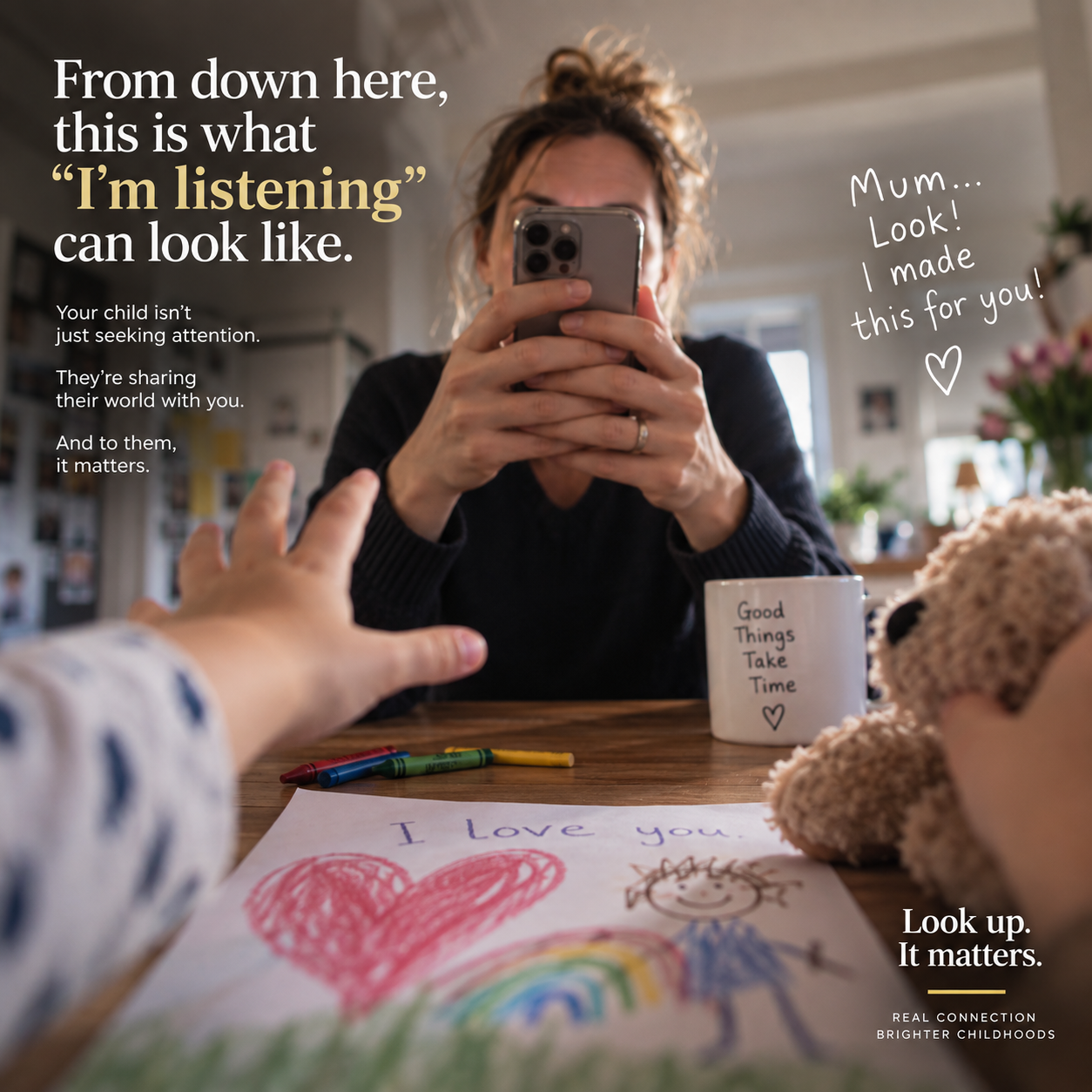
A drawing. A story. A funny stone. “Watch this.” To us, they can seem like little things. To a child, they’re their world.
Look up. It matters.
They’re not just interrupting.
They’re trying to connect.
Children make small bids for our attention all day: a question, a story, a look, something they have made. Responsive, back-and-forth interaction with a caring adult is an important part of early development.
Phones are useful and they are part of family life. This isn’t an anti-phone campaign. It is a reminder that sometimes the screen can wait.
Notice
“Mum, look.” “Dad, listen.” A child’s small interruption may be a bid for connection.
Respond
A look, an answer, a smile or a question back turns a bid into a conversation.
Reconnect
You won’t catch every moment. Nobody does. The aim is simply to make space for more of them.
No grand rules. Just a little more attention.
Look when they show you
Pause for a few seconds and see what they are trying to share.
Protect one or two moments
Try a phone-free meal, school run, bath time or bedtime story.
Give them ten minutes
No phone and no multitasking. Let them choose what you do together.
Say when it can’t wait
“I need to send this message, then I’m all yours.” It makes the interruption understandable.
“The phone isn’t the enemy. But sometimes it gets between us and the little person trying to say: look at me.”
Help us share the message without lecturing parents.
Your Attention Matters is designed to be positive, practical and evidence-informed. The aim is not to shame families or demand unrealistic screen bans.
We are developing a free school pack so nurseries and primary schools can use the campaign consistently.
Register interest in the school packPlanned free resources
- Printable campaign posters
- Social-media graphics
- Parent newsletter copy
- A one-page parent guide
- Evidence and references
- Simple guidance for schools
What the research actually says.
We deliberately avoid exaggerated claims. Research suggests that technology interrupting parent–child interaction can be associated with poorer outcomes, but much of the evidence is observational and effect sizes can be small.
Parental technology use in a child’s presence
A 2025 systematic review and meta-analysis in JAMA Pediatrics included 21 studies and 14,900 participants. It found small associations between parental technology use in a young child’s presence and several cognitive and psychosocial outcomes. The authors explicitly note that the evidence is correlational and more longitudinal and experimental research is needed.
Read the study in JAMA Pediatrics →Responsive “serve and return” interaction
Harvard’s Center on the Developing Child describes responsive, back-and-forth exchanges between children and caring adults as an important part of the child’s developmental environment, supporting early language and social skills.
Read about serve and return →